


The Collective2 database ranks and analyzes all trading systems submitted to us. There are 16,540 systems in our database.
Collective2 users can trade any system in their brokerage account automatically.
too bad the momentum was in the wrong direction
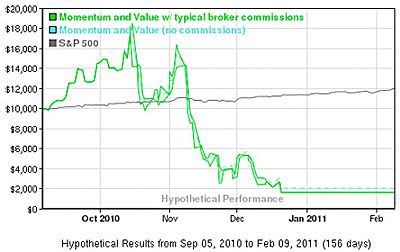
The truth is, this system isn't so bad - it's not in the same class of egregious offenders as the first two we profiled. Sure, it has lost a lot of money; but it didn't flame out in fiery ruin, the way many trading systems do. Rather, it descended slowly and implacably, like a red velvet curtain at the end of a Puccini opera.
It didn't double-down on its bets, Martingale style, and it didn't loudly proclaim that it had discovered a new Cosmic Geometry, or anything silly like that. It just bought long options positions, and watched as they dwindled into worthlessness.
For those of you who aren't familiar with options, this is how they work. Strip away all the mumbo-jumbo, and here's what options are: they are an instrument that allows you to bet where a stock price will be, at a certain date in the future.
There are two ways to trade a single option contract. You can go long the option (that is, buy it), or you can go short (sell it). Selling "naked" options short is commonly perceived to be extremely risky - and indeed it is - so much so, that many brokers do not allow traders to even engage in the practice without a substantial account balance. The reason selling options short is risky is that the amount you can lose is theoretically unlimited.
In contrast, buying an option "long" is often perceived (wrongly, I should point out) as a safer strategy. Well, it's safer in the sense that your loss is bounded by the amount you initially paid for the option. Pay $100 for an option, and that's the most you can lose.
Alas, that doesn't make an option safe. This is because - while your loss is capped at the amount you pay - this doesn't prevent the value of what you bought from plummeting to zero.
For a great example of how this works, study the trades of the Collective2 trading system called Momentum and Value.
Let's look at a specific case. On October 8, 2010, the system bought 33 options contracts that were Nov 13 calls on the stock ReneSola. Now, for those of you who don't live, eat, and breathe options, here's what that means: The system made a bet that on Nov 19, 2010, the stock price for SOL would be greater than $13 dollars per share.
Indeed, on October 8, when the system made this bet... er, excuse me, made this investment... SOL was trading around $13 per share. Here's the chart, courtesy of Google Finance:
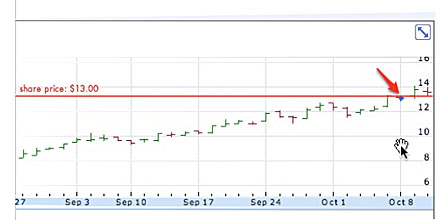
You can see from the chart that this wasn't a crazy or reckless position. After all, the price of SOL (yes, it's an ironic stock symbol, given the outcome) was around $13 at the time the option was purchased.
But the comfort that brokers used to offer to their high-net-worth clients buying options - that you can only lose what you invest, damn it! - is worth studying, in light of this example. The trading system bought 33 contracts, at $120 dollars per contract. That means it laid out about $4,000 in cash.
The day of reckoning came finally on November 19, on "option expiration day." The trading system would have profited handsomely had SOL shares been trading above $13 per share. Alas, SOL closed the day at $9.51.
And here, dear reader, is your lesson in the risks of supposedly less-risky long option buying. The price of SOL ($9.51) was only 27% below the 13 strike price. So did that mean that the option position owned by the Momentum and Value system only lost 27% of its value?
Uh, no. The option expired worthless. Worthless meaning: all $4,000 bucks of the investment were vaporized. Goodbye, thank you, and don't let the door hit you on the way out.
The trading system enjoyed a similar streak of worthless option expirations through the end of last year. Finally, the system retired from Collective2 with a Model Account balance of $2,000. It had started on Collective2 with $10,000. Which means it lost 80% of its value trading in what is generally perceived as low-risk option strategy. Mercifully, there was only one Collective2 Member AutoTrading this system.
